TO EXPERIENCE
At the beginning of the 20th century, Ādaži Parish – in the then Baltic provinces of the Russian Empire and in their areas inhabited by Latvians – was home to two remarkable unique engineering structures – the Gauja-Daugava waterway canals and the Baltezers pumping station. We can be proud of both the engineering development of the time and the work of the people of Ādaži in building these structures. The Gauja-Daugava waterway was a unique system of waterways created to float trees, connecting the Gauja and the Daugava rivers. Previously, intensive floating of trees from the timber extraction areas in Vidzeme to Riga took place along the Gauja, and the last section from the mouth of the Gauja in Carnikava to the mouth of the Daugava – along the Gulf of Riga. This was the most expensive and the most dangerous. Rafts used to break up in the waves. And sometimes we had to wait weeks for the sea to calm down to get the timber to the ports. On the Daugava, too, they had to be hauled upstream for long distances to the sawmills in Mīlgrāvis. In order to avoid such unwieldy transport of timber by sea, the idea of connecting the Gauja and the Daugava was revived in the minds of entrepreneurs. The idea was actually very old, dating back to the 17th century, when it became popular in many parts of the world to create canals for shipping and transporting goods by connecting natural reservoirs. To realise this goal, the Vidzeme Waterways Improvement Company was established, which from 1899 to 1903 developed and implemented the unique Gauja-Daugava waterway project.
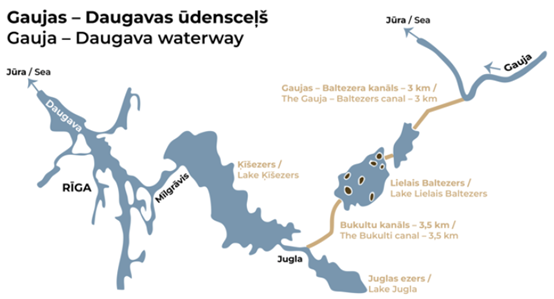
The waterway was 22.3 km long and connected the two rivers. The canal started in Ādaži near Remberģi (now the village of Strautkalni), and continued along the 3.1 km long artificially constructed Gauja-Baltezers Canal until the water flowed into the Lake Mazais Baltezers near Alderi. There was a lock in the middle of the canal. The locks were fitted with a Stoney gate. This shutter could be moved up and down, and its shield moved on ball bearings of a special design to make it easy to move. According to English canal researcher M. Clarke, this was the only time ball bearings were used instead of roller bearings in the widely used Stoney system.
The Gauja-Baltezers Canal was used for rafting only in spring, when the water level in the Gauja was at its highest. The 100 m stretch of the canal downstream of the locks was constructed with wooden boards, as were the walls at the mouth of the canal into the Baltezers. The rest of the section downstream of the locks and the whole section upstream of the locks were reinforced with fascines (bundles of branches tied in a cylindrical shape) or turf. The Gauja-Daugava waterway continued from the Lake Mazais Baltezers through the Lielais Baltezers, and from there, through a 3,5 km long channel and the bed of the Jugla River, the water reached the Ķīšezers and finally, crossing the Ķīšezers and the Mīlgrāvis estuary, reached the Daugava River.
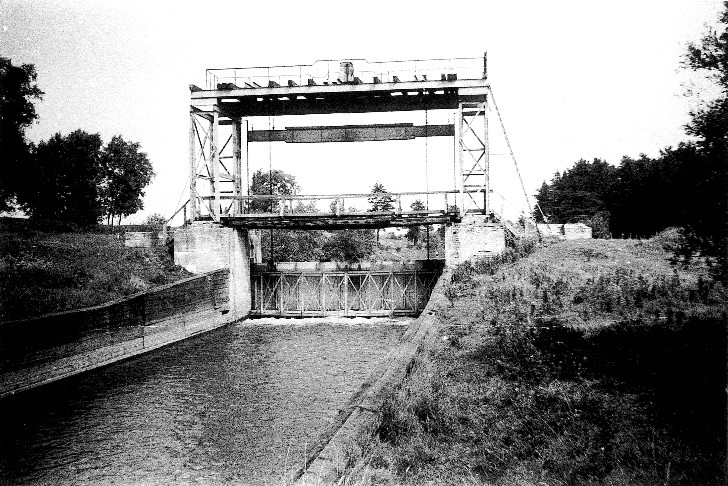
1954. year. The sluice
In the middle of the three-kilometre-long canal, there was a mighty lock that regulated the water level in the lower part of the canal. They were sometimes used to clear log jams by storing water and then rapidly releasing it over the log jam
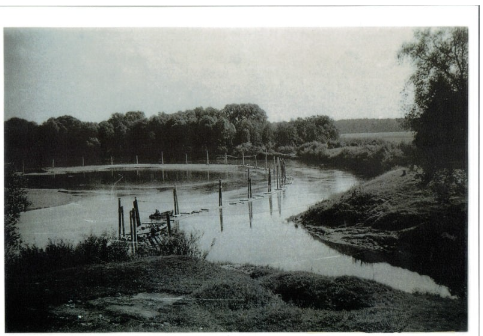
1954. year. Canal entry device
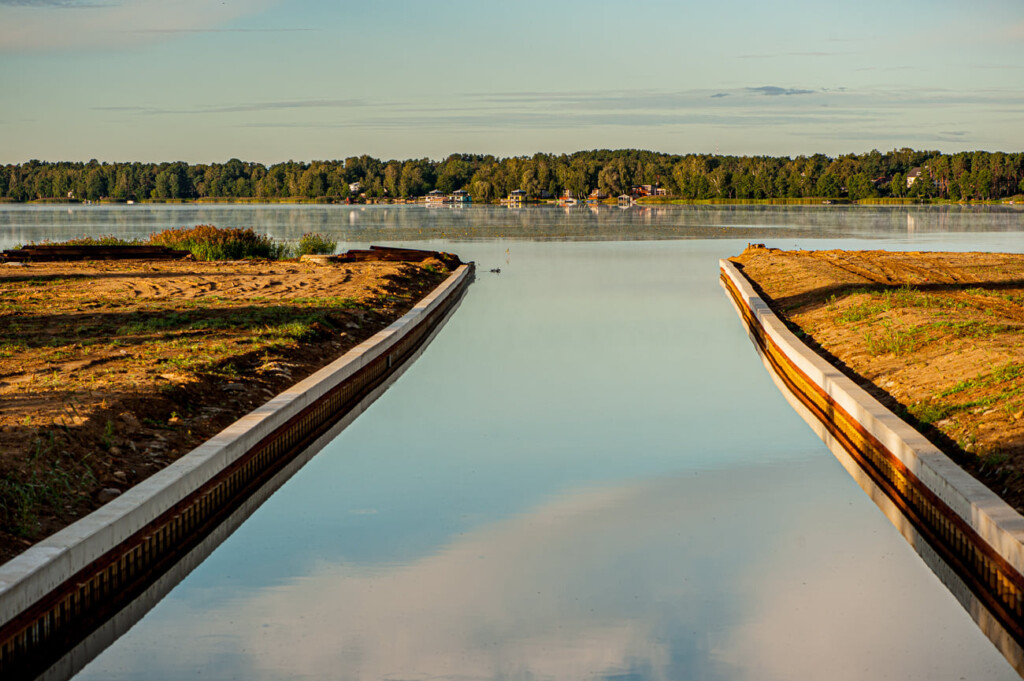
As the waters of the Gauja are allowed free passage to the sea, rafts and logs get diverted into the canal to Lake Mazais Baltezers.
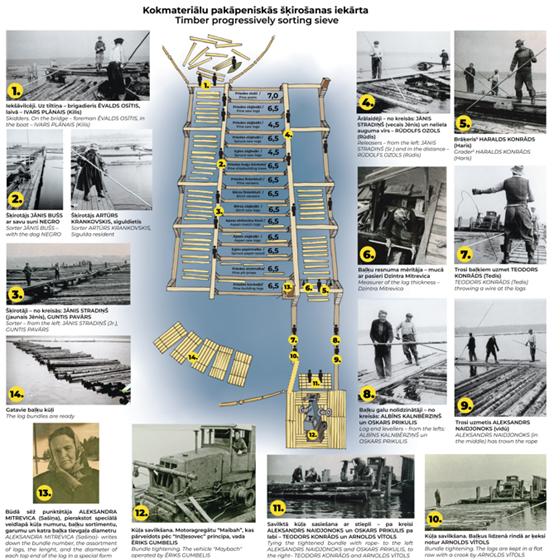
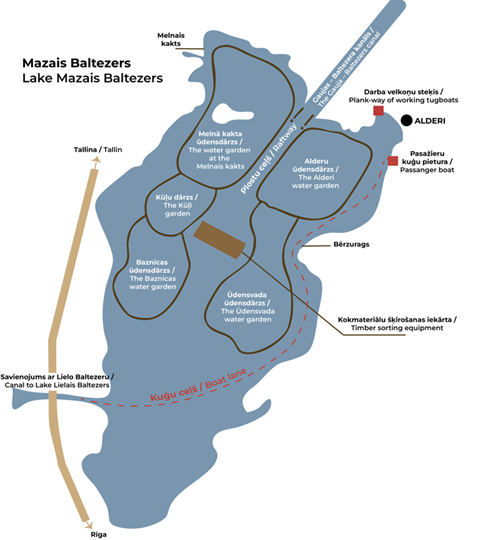
At the lower end of the Gauja-Baltezers Canal, the stream coming from the Gauja ends. Further on, rafts and logs were transported to Riga by tugboats. The rafts were pulled from the mouth of the canal into the lake and tied in the middle of the lake, where they were then towed to Riga – to sawmills, veneer factories and the port. The loose floating logs ended up in water gardens. These enclosure-like gardens were created by attaching single-log sledges to piles. (Log strings are connected by chains and clamps.) The free-floating logs in water gardens were replaced in the 20th century by a series of “log huts”. In the first half of the 20th century, the logs were put into snake rafts, which were also towed by tugboats to Riga. In 1950, a timber sorting plant was built in the Lake Lielais Baltezers. All the logs were sorted into different grades, measured and – with a tractor on the raft – pulled into bundles, which were tied with thick wires by the plankers (tree floaters working in the water gardens). The bundles were made into rejas (2-row caravans of bundles), which were also towed to Riga.
The canal was used by about 1000 rafts a year, and in 1911 by 2522 rafts [ibid]. During the season, the wood rafters had to coordinate their work with the Riga barges, which used the Gauja-Daugava Canal to transport coal from the harbour to the Baltezers pumping station built nearby in 1904 to power the engines there. The Alderi area was very busy at the end of the 19th century and the beginning of the 20th century. A village of tree floaters with its own special history and traditions developed along the canal at Alderi. Due to its magnificent natural scenery, the canal in the Gauja area and the two Baltezers lakes, it was a popular recreational destination for tourists and holidaymakers in 1920s and 30s Latvia. This is evidenced by numerous publications in the press.
The logs flooded into Lake Baltezers were deposited in water gardens – a part of the lake enclosed by piles and rags – which could hold up to 200 000 cubic metres of logs. In the water gardens, the timber was sorted, felted (joined) and sown in bundles to be towed to Riga by the river shipping tugboat via the Lake Lielais Baltezers and Ķīšezers. There were four water gardens in Mazais Baltezers – Alderi, Melnā kakta (‘Black Corner’), Baznīcas (‘Church’) and Ūdensvada (‘Waterline’). After 1950, when a mechanised tree felling plant was built, the bundles tied there were placed in the bundle water garden. In the middle of these water gardens stood a timber grading plant and a flailing unit.